The Australian Stroke Clinical Registry (AuSCR) is a clinical quality registry designed to monitor and improve the quality of acute stroke care. It is a prospective, multi-centre database collecting data on the demographics, presentation, diagnosis, treatment and outcomes of hospitalised patients with stroke.
Variables collected in hospital
The AuSCR collects a range of acute care variables, including relevant processes of care aligned with the Australian Commission of Safety and Quality in Healthcare clinical care standards. Each participating AuSCR hospital agrees to collect a specific set of data variables, represented in different pre-defined colour coded program bundles. These are shown in the diagram below.
Choice of data collection program depends on the preference of the site Principal Investigator, and the types of services for stroke available at the hospital.
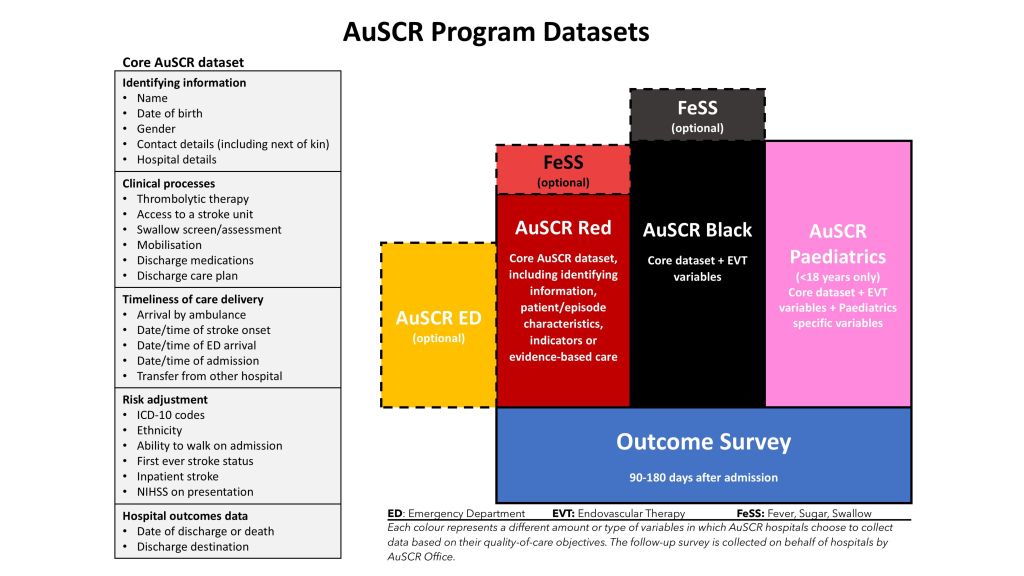
For a comprehensive list of AuSCR acute variables by Program, click here.
To download the full AuSCR data dictionary, click here.
Variables collected after hospital discharge
The AuSCR collects patient outcome data 90 to 180 days post-admission (post-discharge follow-up) to assess survival, health indicators and level of disability. These data are collected centrally by AuSCR Office staff, and include type of residence, rehospitalisation and/or subsequent strokes, quality of life and the modified Rankin Scale (level of disability). The collection of patient outcomes is the same no matter which AuSCR Program bundle a hospital is using.
Data access and summary reports
Hospital clinicians are able to access data from patients treated at their hospital as needed. These data can be viewed via summary data reports accessible at any time online, or exported for local analysis and review as required.
 AuSCR
AuSCR 